Arditi
M: Son of the CenturyThe Arditi appear as a war-forged body of veterans and as an organized presence in Italy’s turbulent postwar streets. Their significance lies in the passage the book traces from military identity to political action: armed men gather in public, escort fascist campaigns, and take part in confrontations, while their uniforms, weapons, pennants, and martial rituals make the war seem to continue by other means. The narrative does not treat every Arditi as part of a single, fully described organization; instead, it shows how the name and its veteran associations became a potent force within the emerging fascist movement.
Veterans and the Postwar Crowd
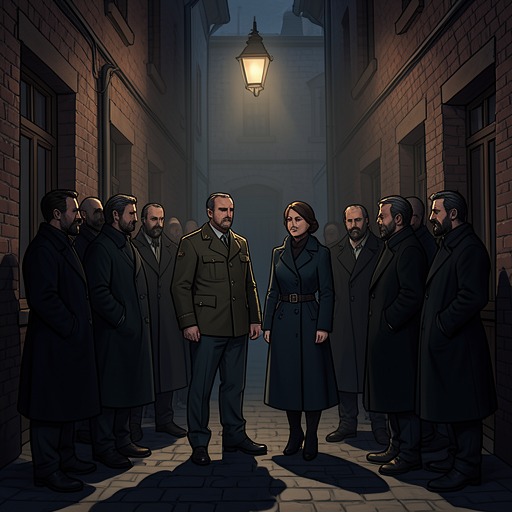
The Arditi belonged to a wider population of ex-soldiers returning to a country still marked by mass death and unsettled political conflict. The book frames the veterans as survivors of the front, a generation whose experience of violence separated them from civilians and from older political habits. In Milan, that division becomes visible during a socialist procession: women at the head of one column carry Lenin’s portrait and a red flag, while the much smaller opposing cortege includes men accustomed to daily proximity to killing. The contrast is not merely numerical. The groups carry different expectations of death, and the scene presents that difference as an abyss between them.
At the April 1919 clash, the Arditi stand among officers and Futurists opposite the socialist marchers. After the carabinieri cordon opens, armed men advance in small groups, with revolvers in hand. The encounter lasts about a minute: stones and a few clubs come from the socialist side; gunfire comes from the opposing side, first into the air and then toward the column. The singing stops, and the marchers fall silent. The scene makes the Arditi’s presence part of a rapid transformation of a public demonstration into an armed confrontation, rather than an abstract symbol of postwar militancy.
Weapons, Escorts, and Mobilization
In the 1919 electoral campaign, Benito Mussolini prepares for likely attacks by bringing old republicans and anarchists from Romagna to stand beside him, with Leandro Arpinati again assigned to watch his back. Gabriele D’Annunzio sends sixty legionnaires and authorizes the use of additional men with money raised for Fiume. Fascists also arrive from nearby cities. The evidence distinguishes these groups rather than identifying every escort as an Arditi unit, but the campaign’s preparations draw on the same veteran culture of organized protection and force.
The arrangements are specific. Travel and an overnight stay are reimbursed at thirty lire per person; Roberto Farinacci asks for one hundred lire for four men, arguing that they are experienced offenders prepared for any task. Albino Volpi and other Arditi fill backpacks with iron bars and grenades. Mussolini instructs the fascist bloc to remain silent if asked to identify those who cause disturbances, to clear uninvolved members of the public quickly through Via Morone if clashes occur, and to hold the rally briefly, even in the rain. The weapons and instructions place intimidation and concealment alongside the public campaign itself.
A separate episode shows Volpi alone on the Bridge of the Sirenette, watching a socialist procession celebrating its electoral victory. He carries two Thévenot grenades and a dagger with a mother-of-pearl handle. He has reached the bridge by climbing over the wall of Palazzo Visconti and crossing its garden, avoiding observation from the Arditi headquarters on Via Cerva. The account establishes his surveillance, equipment, and concealed route; it does not, in this passage, describe him carrying out an attack. Its focus is the presence of a lone armed veteran beside a mass procession, and the stark contrast between the marching crowd and his isolated position.
Public Ritual and the Fiume Connection
The Arditi’s identity also took ceremonial form. At the opening of the Second National Congress of the Fasci di Combattimento, held at the Teatro Lirico, new pennants are unveiled for the Arditi and the fascists. The flags had been kept beneath pastel-colored tissue paper. Ferruccio Vecchi receives the Arditi pennant and makes a defiant declaration against the hammer and sickle; Benito Mussolini receives the fascist pennant and promises a renewed place for the Arditi in national life, alongside the claim that Fiume will become Italian. Uniformed soldiers form a semicircle onstage, flags fill the set, and a choir of girls sings beneath them. The congress makes a political meeting resemble a staged military ceremony.
The connection to Gabriele D’Annunzio’s Fiume is reinforced by the daily routine around his command. At dawn, he appears in boots and spurs and an Ardito jacket, takes roll call, and leads different regiments on excursions through the valleys surrounding the city. Three trumpet blasts begin the marches. The military appearance and ordered departure give way to scattered groups returning with branches and flowers. In this episode, the Arditi image is part of a broader performance of comradeship and martial life, rather than evidence that every participant belongs to a single Arditi unit.
The Milan Headquarters and Police Raids
On November 18, 1919, police raid the headquarters of the Italian Arditi Association on Via Cerva. They seize SIPE grenades, Thévenot grenades, pistols, daggers, maces, and boxes of ammunition. Ferruccio Vecchi, Piero Bolzon, and Edmondo Mazzucato are arrested. Albino Volpi and other veterans suspected of involvement in the earlier attack on Via San Damiano escape capture over the rooftops. The raid turns the association’s weapons and premises into direct evidence of the conflict between armed political groups and the state.
The police continue their searches that afternoon, including at the fascist headquarters and the offices of Il Popolo d’Italia. At the newspaper they find revolvers, cartridges, and a recently used flare gun; Umberto Pasella, Enzo Ferrari, and Filippo Tommaso Marinetti are arrested, and Benito Mussolini is taken to San Vittore Prison. He is released the following day after Luigi Albertini intervenes with Prime Minister Francesco Saverio Nitti. The sequence broadens the significance of the Arditi raid: the authorities are investigating not only a veterans’ association but an interconnected world of fascist offices, armed personnel, and political leadership.
Organization and Political Meaning
The individual profiles associated with the Arditi show the range of people drawn into this world. Giuseppe Bottai is described as a volunteer in the Arditi, wounded and decorated, who later founds the Fasci di Combattimento in Rome and organizes local action squads. Guido Keller is a highly decorated war hero and an adherent of D’Annunzio. Ettore Muti falsifies documents as a teenager to volunteer, later joining the Uskoks in Fiume, while Aldo Tarabella is identified as a decorated Arditi captain and an early member of the Milan fascio. Ferruccio Vecchi combines the roles of decorated captain, founder of the National Arditi Federation of Italy, and participant in the San Sepolcro movement. These biographies establish overlap among wartime service, Fiume, local fascist organizing, and veteran associations without making those institutions identical.
The Arditi’s political meaning is therefore conveyed through a recurring set of concrete forms: the armed escort, the concealed grenade, the marching column, the pennant, and the raid on the association’s headquarters. Those forms turn military experience into a public language of discipline and force. In the socialist procession, that language helps produce a confrontation; in the congress hall, it becomes ceremony; in Fiume, it is woven into D’Annunzio’s daily performances of command. The organization’s narrative role is not confined to membership or formal structure. It helps explain how a recognizable veteran identity could be recruited into competing political projects, and how the symbols of wartime service became instruments of mobilization in the postwar crisis.